
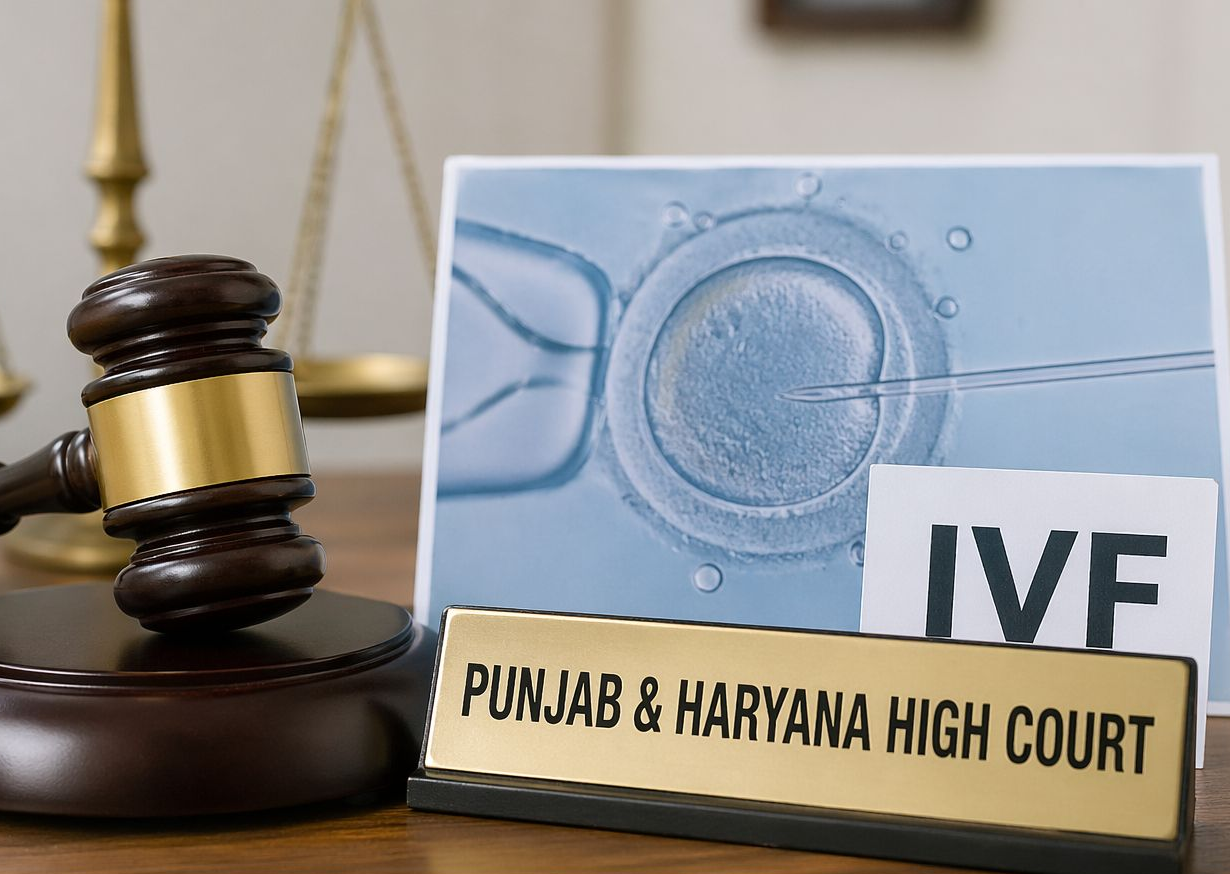
A noteworthy judgment recently passed by the Punjab and Haryana High Court - Veena Kumari alias Avinash Kaur Dhillon and another v. Union of India and others (CWP No. 24686-2025, decided on 02.04.2026) - marks a significant and progressive step forward in the evolving jurisprudence surrounding Assisted Reproductive Technology (ART) and the reproductive rights of couples in India.
The Assisted Reproductive Technology (Regulation) Act, 2021 ('the ART Act') brought with it, for the first time in India, a statutory age ceiling on individuals seeking ART services. Under Section 21(g) of the ART Act, ART clinics are mandated to provide services only to women between 21 and 50 years of age, and to men between 21 and 55 years of age. While the legislative intent behind these restrictions was ostensibly to protect the welfare of commissioning couples and children born through ART, the rigidity of these age bars soon began to collide with the lived realities of couples who had already commenced their treatment journeys before the Act came into force.
The Punjab and Haryana High Court has been at the forefront of addressing these collisions. In Manjeet Kaur and Another v. Union of India, the Court took the foundational position that Section 21(g) of the ART Act prescribes age limits individually and gender-wise-applicable separately to the man and the woman- and not to a married couple as a composite unit. This interpretation was significant in itself, but the cases that followed pushed the boundaries even further. In Sarbjit Kaur and Another v. State of Punjab and Others (decided on 22.01.2026), a couple who had tragically lost their only son in 2024 sought IVF treatment, but were denied on the ground that the husband had crossed the prescribed age of 55 years. Relying on Manjeet Kaur and the Calcutta High Court's ruling in Shyamoli Saha and Another v. State of West Bengal and Others (AIR 2025 Calcutta 55), the Court reiterated that the age restriction under the ART Act applies to individuals, not to couples, and accordingly allowed the couple to proceed. However, it is important to note that both these earlier cases turned on the husband having crossed the male age threshold of 55 years, the question of a woman crossing the female age threshold of 50 years had not yet been directly confronted.
It is precisely this gap that the latest judgment in Veena Kumari fills. The petitioners, a husband and wife residing in Canada, had approached Jindal IVF and Sant Memorial Nursing Home for ART services. When they first commenced treatment, both were within the permissible age range, being 47 and 48 years respectively. In December 2019, respondent No. 4, after Pre-Implantation Genetic Testing (PGT), successfully created four embryos. One child was born from these embryos. The remaining three embryos were preserved at the hospital, and the petitioners now sought to have a second child through the transfer of these preserved embryos. However, petitioner No. 1 (the wife) had since crossed 50 years of age, and therefore faced the statutory bar under Section 21(g) of the ART Act.
Argued before Justice Jagmohan Bansal by counsel Aerika Singh and Kunal Thapa of KTB Law Offices for the Petitioners, the case was presented squarely on the foundation of the Sarbjit Kaur judgment. It was contended that the petitioners were in fact on better footing than those in Sarbjit Kaur, since both petitioners had been well within the prescribed age limits when the embryos were lawfully created in 2019. The Court, accepting this argument, allowed the petition and directed respondent No. 4 to proceed with further treatment. What makes this judgment distinctly significant is that it is the first instance in the Punjab and Haryana High Court where the protection has been extended specifically to a woman who has crossed the female age threshold of 50 years- as opposed to the earlier cases where only the male spouse had exceeded the age of 55.
The underlying legal reasoning in Veena Kumar draws its deepest sustenance from the landmark Supreme Court judgment in Vijaya Kumari v. Union of India (2025 INSC 1209, decided on 09.10.2025), which, though rendered in the context of the Surrogacy (Regulation) Act, 2021, enunciated principles of far-reaching applicability. In Vijaya Kumari, a bench of Justices B.V. Nagarathna and K.V. Viswanathan held that where intending couples had already commenced surrogacy procedures i.e. crystallised by the creation and freezing of embryos prior to the Surrogacy Act coming into force on 25.01.2022, the age-bar introduced by the Act could not be applied retrospectively to them.
The parallel between Vijaya Kumari and Veena Kumari is both direct and compelling. Taken together, these judgments trace a clear and coherent judicial arc. The ART Act and the Surrogacy Act, while enacted with laudable protective objectives, contain age restrictions that were not designed with adequate transitional safeguards for couples who had already taken concrete, irreversible steps towards parenthood under the prior legal regime. The courts have stepped in to fill that gap by ensuring that they apply only prospectively to those commencing treatment after the Acts came into force, and not retroactively to those whose reproductive journeys had already begun. In doing so, the judiciary has reaffirmed that the fundamental right to reproductive autonomy guaranteed under Article 21 of the Constitution cannot be sacrificed at the altar of legislative transition.
Read Judgment: https://indiankanoon.org/doc/92662243/
Read News:
- https://www.tribuneindia.com/news/punjab/hc-clears-fertility-treatment-for-canada-based-couple/
- https://www.courtkutchehry.com/pages/blog/ivf-after-50-art-act-india-hc-ruling/
- https://www.jagran.com/punjab/chandigarh-the-punjab-and-haryana-high-court-granted-significant-relief-to-a-woman-over-50-years-of-age-to-have-a-second-child-through-ivf-40205546.html
- https://www.punjabitribuneonline.com/news/haryana/relief-from-high-court-to-canada-based-couple-ivf-treatment-allowed-for-second-child-at-age-50/
More Articles
-
Entry Options for Foreign Companies entering India (2025 Update)
26 Jun 2025
-

Setting Up Solar Power Projects in Haryana: A Legal & Regulatory Overview (2025)
25 Jul 2025
-
Setting Up Retail Operations for Imported Cosmetic Products in India - Legal & Regulatory Overview 2025
15 Jun 2025
-

Government Dues vs. IBC Protection: Can Tax Authorities Pursue Pre-CIRP Dues?
01 Jul 2025